
Creativity Is Not a Talent. It May Be a Leadership Condition.
For a long time, I almost convinced myself that I was not a creative person.
In my previous life as a corporate executive, I was rewarded for other things:
Strategic thinking.
Making decisions.
Solving problems.
Getting things done.
Performance mattered. Logic mattered. Results mattered.
And I became very good at operating in that world.
But underneath that competence, there was sometimes another voice:
What if the world changes?
What if my industry disappears?
What if the capabilities that made me successful are no longer enough?
There was an assumption hiding underneath all of this:
I know how to perform. But I am not sure I know how to create.
Years later, I met a coaching client experiencing something very similar.
She was highly capable, successful, responsible—and tired.
In one conversation, we explored a different question:
If you felt completely safe for a moment, with no expectations and no need to prove anything, what would make you feel alive?
Her answer was simple.
Painting.
So she created one morning each week to paint.
Not to become an artist.
Not to produce anything useful.
Just to paint.
Something shifted.
She became more spacious, playful and alive.
And interestingly, some of the complex problems she was facing at work also began to look different.
Ideas appeared. Connections emerged. Solutions came without being forced.
Why this matters for leaders
We often think of creativity as something artistic.
But for leaders, creativity is much broader.
Leadership is not only about executing known answers.
It is also about what happens when the known answer is no longer enough.
When markets shift.
When technology changes.
When teams get stuck.
When yesterday’s strategy stops working.
In those moments, leadership depends on the ability to see possibilities.
Creativity helps us move beyond either/or thinking. It helps us connect things that previously seemed unrelated, stay with ambiguity a little longer, and imagine options that were not obvious before.
Performance helps us deliver within the known.
Creativity helps us lead when the known is changing.
And perhaps creativity is less about talent than about conditions.
Under pressure, our attention naturally narrows.
We focus. We assess. We execute. We try to avoid mistakes.
Useful capacities—but not the only ones leaders need.
We also need imagination, intuition, pattern recognition and the ability to notice what is not yet obvious.
That may require space.
Try this
Take a blank sheet of paper and draw something.
Anything.
A circle. A tree. Two shapes.
Now notice where your attention goes first.
Probably to the object.
Then try something different.
Look at the space around it.
Notice the empty areas.
The distance between forms.
What is not drawn.
Stay there for a moment.
The page has not changed.
But the way you are seeing it may have.
This is also how I think about coaching
People sometimes ask me:
“What actually happens in coaching?”
Perhaps this is one answer.
A coaching conversation does not necessarily give you another object to focus on.
Sometimes it helps you notice the space around the object.
The assumptions underneath the problem.
The relationships around it.
The part of you that has not yet been invited into the conversation.
The possibility you could not see while trying so hard to solve the problem.
For leaders, this matters because senior roles often reward certainty.
You are expected to know.
To decide.
To act.
But leadership also requires the capacity to stay with what is not yet clear.
A good coaching conversation can create that space—not to slow someone down, but to widen the field.
And when two people meet with enough presence and curiosity, something else can emerge between them.
A question leads somewhere unexpected.
A silence becomes meaningful.
A thought connects with a feeling.
Something previously tangled becomes clearer.
We do not manufacture insight.
We create conditions in which insight has a better chance of appearing.
Perhaps that is true of leadership too.
A strong leader does not need to have every idea.
They create conditions where people can think, question, challenge and imagine.
What do you notice?
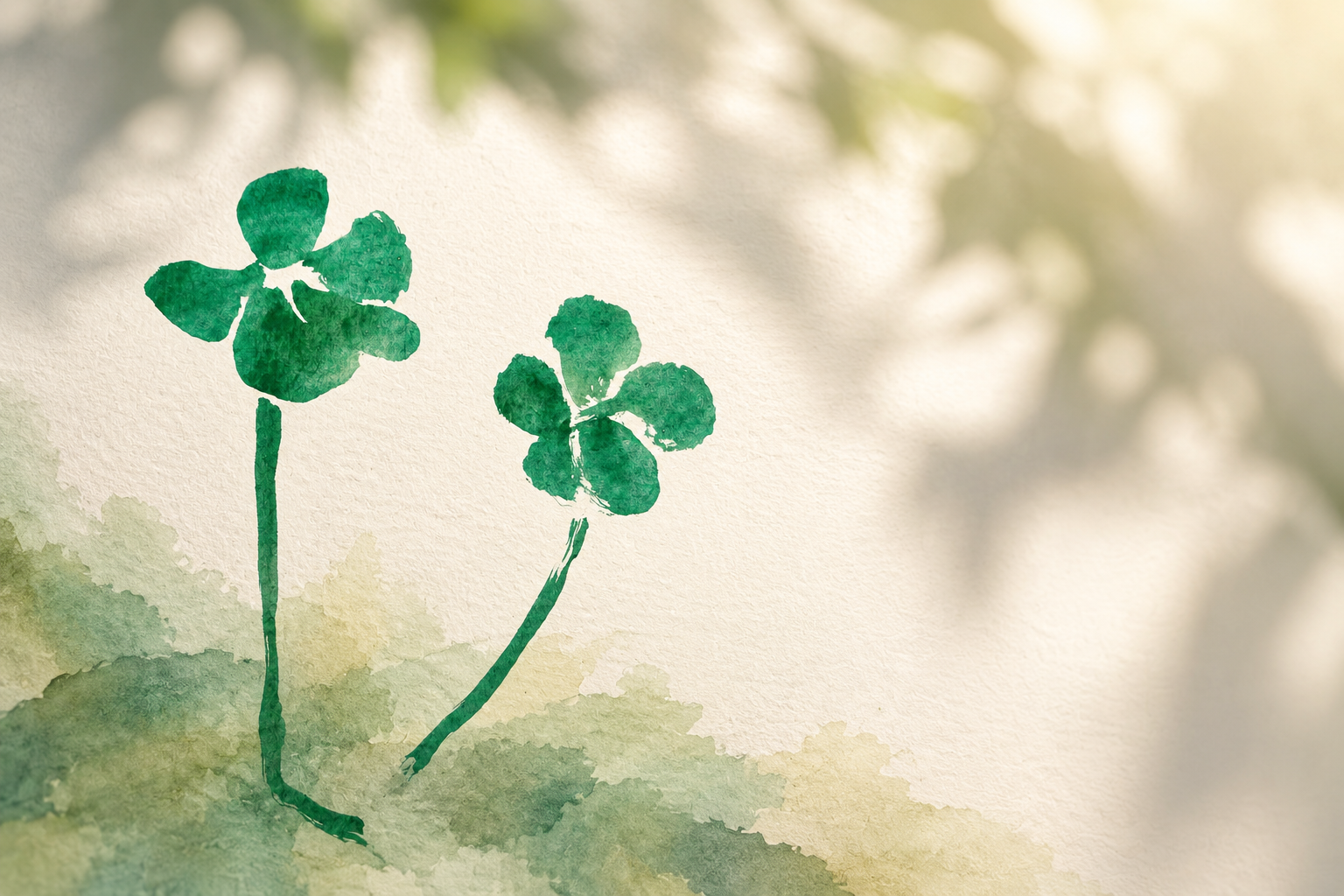
When I created this painting, I was thinking about relationship.
Where does your eye go first?
To the objects?
Or to the space between them?
And what happens when you deliberately shift your attention?
Perhaps creativity begins there.
Not by trying harder.
But by seeing more.
And sometimes, that is exactly where a beautiful coaching conversation begins.